Arkansas & Jonesboro
Is Arkansas Safe?

Is Arkansas Safe?
This is a very natural question for prospective students, parents and international students exploring what life in the US is like. The short answer is: Arkansas cannot be described with an overly simple conclusion like "very safe" or "unsafe." Like many other US states, the level of safety in Arkansas depends a lot on the specific area, the specific city, and even each person's daily habits.
A Realistic Look at Safety in Arkansas
When talking about safety, the most important thing is to avoid viewing Arkansas as a single, uniform whole. There are peaceful areas, small communities, and stable living environments well suited to students. At the same time, there are also places that call for more caution, especially if you're not familiar with the local context or haven't done your research before moving there.
For international students, the right question should be: "Is the area where I'll live and study a good fit, with a solid support system and clear campus safety measures?" Statewide statistics are only one reference point, but a student's actual experience is usually shaped much more by the city, the housing area, and the university environment itself.
Overall Security Situation in Arkansas
Avoid Oversimplified Descriptions
- Arkansas isn't a state that should be described as "completely peaceful everywhere."
- Current data shows that Arkansas should be viewed realistically, with distinctions made between different areas.
- This doesn't mean students shouldn't choose Arkansas; it simply means the school, city, and living area should be chosen with good information in hand.
What Matters Most for International Students
- Most students don't experience "the whole state of Arkansas" — they live within a very specific ecosystem: campus, housing, shopping areas, travel routes, and the surrounding community.
- That's why safety in the study-abroad experience is tied much more closely to the school you choose and how you live day to day.
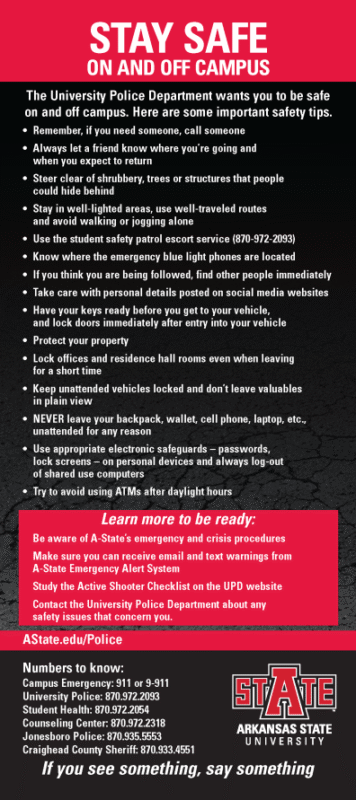
- A campus with its own police department, emergency alerts, an escort service, and clear emergency procedures usually makes a very significant difference.
The Real Question Isn't Just "Is Arkansas Safe?"
A more useful question is: "Is the city I'm about to live in welcoming, is my housing area a good fit, does the campus I'll attend have a strong safety system, and do I already know how to protect myself?"
Safety Within the University Environment
For international students, what matters most usually isn't a general impression of the whole state, but the level of safety within the university environment where they'll actually study. At Arkansas State University, campus safety has been built into a clear, accessible system with multiple layers of support for students.
Campus Safety at A-State
- University Police operates 24/7.
- The university currently highlights more than 1,100 cameras supporting prevention and incident investigation.
- Students can use the 24/7 safety escort service if they feel uneasy walking alone on campus.
- Campus Safety also maintains a Daily Crime Log, an Annual Security Report, and crime-prevention guidance.
Other Support Channels Beyond Campus Police
- The Student Health Center supports basic medical needs.
- Counseling Services supports mental health and crisis intervention.
- Title IX supports reporting of sexual harassment, discrimination, or other inappropriate conduct.
- Student Conduct and the Emergency Action Plan help students understand clear response procedures in an emergency.
Why the Learning Environment at A-State Remains a Reassuring Choice
What puts many students at ease at A-State isn't a promise of "zero risk," but the fact that the university provides real, practical safety tools students can use every day: a campus police force, an escort service, emergency alerts, severe weather response procedures, and multiple points of support whenever students need help.
This is the kind of safety that matters most to students: not the feeling that "everywhere is perfect," but knowing that if something happens, you know exactly who to call, where to go, and what kind of support you'll receive.
Practical Advice for Coming to Arkansas
In Everyday Life
- Research the area you'll be living in carefully before signing a housing contract or lease.
- Avoid walking alone at night in quiet areas unless necessary.
- Lock your room and car doors, and don't leave valuables in plain sight.
- Don't leave large amounts of cash or valuables unattended.
Within the University Environment
- Sign up for A-State Alerts and keep your phone ready to receive notifications.
- Know the names of buildings, your location on campus, and safe routes back to your residence hall.
- Save the University Police number and other necessary support contacts.
- If you feel uneasy walking on campus, use the escort service rather than trying to walk alone.
Conclusion
Arkansas shouldn't be summed up with a simple conclusion like "completely safe" or "dangerous." A more accurate way to look at it is that this is a state with clear differences between areas, and a student's experience depends heavily on the city, the campus, and their daily habits.
For students at Arkansas State University, it's worth noting that the university has a fairly clear campus safety system, multiple layers of support, and practical tools to help students feel more at ease in both their studies and daily life. By choosing the right environment, researching thoroughly from the start, and maintaining basic safety habits, you can absolutely build a positive study-abroad experience in Arkansas.
Frequently Asked Questions
Is Arkansas safe?
Should international students focus more on the whole state or the specific area where they'll live?
Does A-State have a safety system for students?
What if I feel uneasy walking alone on campus?
What helps students stay safer while living in Arkansas?
Want to learn more about life and safety at A-State?
Contact the Arkansas State University Vietnam Office for more guidance on the city of Jonesboro, student life, campus safety, and what to prepare before enrolling.
Learn More
This article was translated from Vietnamese and is being reviewed by our admissions team.