Programs
Study Public Health at A-State


The field of Public Health focuses on promoting and protecting health by preventing disease and illness in communities. The Centers for Disease Control and Prevention (CDC) outlines 10 Essential Public Health Services centered on equity, assessment, policy development, and assurance. Public Health uses evidence-based, data-driven strategies to improve health.
Public Health education focuses on 5 core disciplines:
- Biostatistics
- Epidemiology
- Environmental Health Sciences
- Health Policy and Management
- Social and Behavioral Sciences
10 ESSENTIAL PUBLIC HEALTH SERVICES
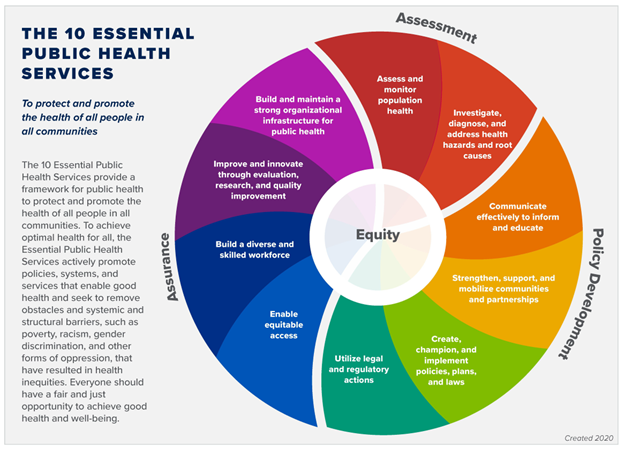
The 10 Essential Public Health Services provide a public health framework designed to protect and promote the health of all people in all communities.
To achieve optimal health for all, the Essential Public Health Services actively promote policies, systems, and services that support good health and seek to remove obstacles as well as systemic and structural barriers—such as poverty, racism, gender discrimination, and other forms of oppression—that have led to health inequities. Everyone must have a fair and just opportunity to achieve good health and well-being.
- Assess and monitor population health status, factors that influence health, and community needs and assets
- Investigate, diagnose, and address health problems and hazards affecting the population
- Communicate effectively to inform and educate people about health, the factors that influence it, and how to improve it
- Strengthen, support, and mobilize communities and partnerships to improve health
- Create, champion, and implement policies, plans, and laws that impact health
- Utilize legal and regulatory actions designed to improve and protect public health
- Ensure an effective system that enables equitable access to the individual services and care needed to be healthy
- Build and support a diverse and skilled public health workforce
- Improve and innovate public health functions through ongoing evaluation, research, and continuous quality improvement
- Build and maintain a strong organizational infrastructure for public health
CAREER OPPORTUNITIES
Career paths in public health include health education, community health, epidemiology, biostatistics, health administration, environmental health, and health policy. The US Bureau of Labor Statistics has projected continued growth across all of these public health career paths.
LEARNING OBJECTIVES
The learning outcomes of the A-State Public Health program are listed below and align with the Council on Education for Public Health (CEPH), the accrediting body for Public Health. Students enrolled in the A-State Public Health program will:
- Understand how to assess and monitor population health
- Learn how to investigate, diagnose, and address health hazards as well as their root causes
- Develop effective public health communication strategies to inform and educate
- Develop public health strategies to strengthen, support, and mobilize communities and partnerships
- Learn how to create, advocate for, and implement public health policies, plans, and laws
- Understand how to use legal and regulatory public health actions
- Identify pathways that enable equitable access to health care
- Contribute to building a diverse and skilled public health workforce
- Develop strategies to improve and innovate through public health evaluation, research, and quality improvement
- Learn how to build and maintain a strong organizational infrastructure for public health
Contact the Vietnam Office for detailed guidance.
This article was translated from Vietnamese and is being reviewed by our admissions team.